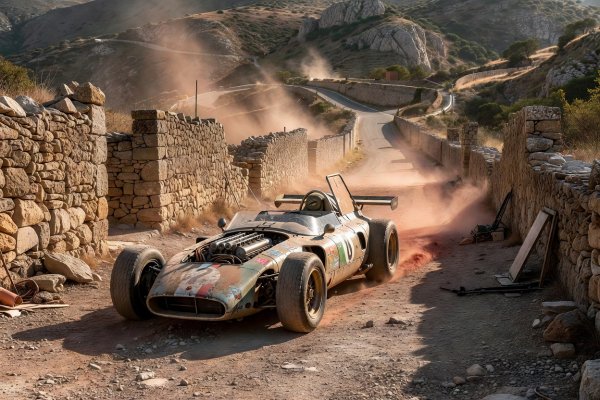
Open-road crucible: Targa Florio and the Mille Miglia
Before purpose-built circuits with smooth asphalt run-off areas became the norm, Europe’s premier manufacturers tested their chassis on broken public roads. On Sicily’s 72-kilometer Piccolo Circuito delle Madonie used for the Targa Florio, a single lap contained more than 800 corners climbing from sea level at Campofelice up into the rocky Madonie mountains. Cars launched at intervals against the clock, meaning drivers had to memorize blind crests where a wooden cart or washed-out culvert might appear around any bend.
In the 1955 Mille Miglia, Mercedes-Benz entered the W196S 300 SLR driven by Stirling Moss and navigator Denis Jenkinson. Because their car departed Brescia at 7:22 a.m., it carried race number 722 painted across its silver magnesium-alloy Elektron bodywork. Rather than driving on sight alone against local Italian pilots who knew the Futa and Raticosa passes by heart, Jenkinson spent weeks recording every hump, railway crossing, and blind corner onto an eighteen-foot paper roll. Using fifteen hand signals, Jenkinson fed Moss instructions at speeds exceeding 170 mph, finishing at an average speed of 97.96 mph (157.65 km/h)—a record that stood forever when the open-road speed race ended after 1957.
The FIA homologation game: Building road cars from the stage backward
Under the International Sporting Code’s Appendix J, manufacturers wishing to compete in Group 4 Special Grand Touring had to prove a minimum production run—initially 500 cars within twelve months, later lowered to 400. Most marques modified existing family saloons, seam-welding Ford Escort shells or fitting aluminum doors and Perspex rear windows to the Alpine-Renault A110 and Lancia Fulvia Coupé 1.6 HF.
In 1971, Lancia competition director Cesare Fiorio decided to dispense with compromise altogether. The resulting Lancia Stratos HF (Progetto Tipo 829) was designed from a blank sheet purely to win rallies. Styled by Marcello Gandini at Bertone with a wraparound crescent windshield that gave unobstructed downward vision on tight hairpins, the Stratos mounted a 2.4-liter Ferrari Dino V6 transversely behind the seats. Its entire front and rear fiberglass clamshells hinged open in seconds, allowing service crews parked on frozen roadside turnouts at the Monte Carlo Rally to swap ratios or change suspension arms in under fifteen minutes.
1982–1986: The brief, ferocious zenith of Group B
When the FISA introduced Group B regulations in 1982, the minimum production requirement dropped to just 200 road-going examples, with an additional 20 “Evolution” cars permitted to homologate radical aerodynamic and mechanical updates. Freed from mass-production stamping constraints, engineers turned to Kevlar-reinforced composite bodywork, mid-engine tubular spaceframes, and viscous-coupled all-wheel drive.