From ash timber frames to the Superleggera lattice
During the 1920s, ordering a serious sporting automobile meant purchasing a rolling chassis—engine, radiator, firewall, and axles—from Bentley, Alfa Romeo, Hispano-Suiza, or Bugatti, and shipping it by rail to an independent coachbuilder. Traditional houses built bodies the way nineteenth-century carriage makers worked: framing the cabin in seasoned European ash reinforced with iron brackets, then pinning aluminum or steel panels over the wood.
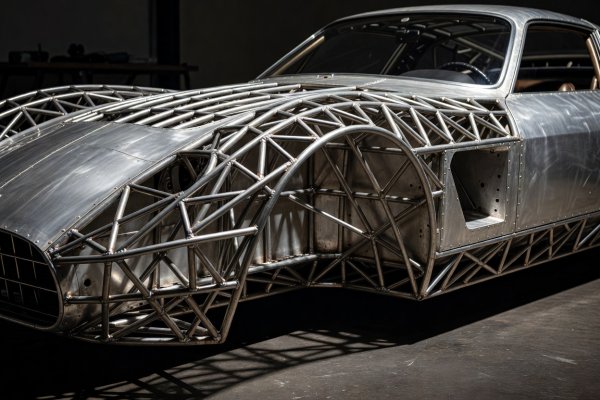
When speeds on events like the Mille Miglia climbed past 100 mph, heavy wooden frames creaked and split. In 1936, Felice Bianchi Anderloni of Carrozzeria Touring in Milan patented the Superleggera system. Drawing on aircraft fuselage construction, Touring welded a three-dimensional cage of thin steel tubes—often just 8 mm to 14 mm in diameter—directly onto the main chassis rails. Workers then hammered Duralumin panels over wooden bucks and hooked the folded edges of the aluminum around the outer tubes, insulating the metal-to-metal contact with tarred felt paper to stop galvanic corrosion and squeaks.
The result shaved more than 120 kilograms off an Alfa Romeo 8C 2900B Berlinetta and allowed continuous, compound curves across the fenders and cabin waist that would have been impossible with flat carpentry joints.
Airship science and the Kamm tail compromise
Popular automotive myth often credits 1950s stylists with discovering aerodynamics through jet-age intuition. In reality, the foundational math was completed in the early 1920s by Paul Jaray, the chief aerodynamicist at the Luftschiffbau Zeppelin works in Friedrichshafen. Using the Zeppelin wind tunnel, Jaray proved that a half-teardrop body sitting close to the road with a smoothly tapering tail reduced drag coefficients from the 0.65 typical of upright tourers down below 0.30. Hans Ledwinka at Tatra put Jaray’s patents into series production in 1934 with the rear-engined Tatra T77.
Yet a pure Jaray teardrop required an impractically long overhang behind the rear axle. At the Research Institute for Automotive Engineering in Stuttgart, Wunibald Kamm demonstrated that if a tapering roofline and side profile were abruptly sliced off vertically at the point where airflow began to separate, low-pressure wake turbulence remained remarkably small. This truncated “Kammback” or Coda Tronca gave 1960s endurance racers—from the Ferrari 250 GTO and Alfa Romeo Giulia TZ to the Aston Martin Project 214—high top speeds down the Mulsanne Straight without the tail-heavy handling of an elongated fuselage.
Three coachbuilding houses and their telltale physical cues
- Zagato (Milan): Founded by Ugo Zagato in 1919 with aviation background; famous for the Doppia Gobba (double-bubble) roof stamping, which raised two shallow blisters over the driver and co-driver helmets while keeping the central roof channel low and rigid against drumming.
- Bertone (Turin): Under chief stylists Franco Scaglione and later Marcello Gandini, Bertone favored tensioned, razor-edged folds, ultra-low cowl heights made possible by canted engines, and dramatic wheel-arch cutouts that exposed mechanical hardware.
- Pininfarina (Turin): Battista “Pinin” Farina championed the integrated “cisitalia” pontoon fender line of 1947, bringing the hood height below the front wing crowns and creating an unbroken horizontal beltline from headlamp to taillight.